Key Takeaways
- Chandigarh is a Union Territory that serves as the joint capital of Punjab and Haryana.
- French architect Le Corbusier designed the city’s grid of numbered sectors in the 1950s.
- The city covers roughly 114 square kilometers and holds a population of just over a million.
- Sukhna Lake, the Rock Garden, and the Capitol Complex remain its most visited landmarks.
- Panjab University and PGIMER anchor Chandigarh’s reputation in education and healthcare.
Chandigarh is a Union Territory in northwestern India that serves as the shared capital of Punjab and Haryana. Unlike most Indian cities that grew organically over centuries, Chandigarh was designed from scratch after independence, giving it a distinctly different character from its neighbors. Consequently, the city is often studied as one of the world’s few fully planned urban experiments.
Chandigarh sits near the Shivalik foothills, roughly 260 kilometers northwest of Delhi, and covers about 114 square kilometers. Furthermore, its population crossed one million as of the last census, spread across more than fifty numbered sectors. This guide covers Chandigarh’s history, layout, attractions, and daily life, so first-time visitors and long-term residents alike can understand what makes the city work.
What Is Chandigarh?
Chandigarh functions as both a city and a Union Territory, a rare dual status in India. Administratively, it answers directly to the central government rather than to Punjab or Haryana, even though it serves as the capital for both states. As a result, Chandigarh Administration handles civic functions that would normally fall to a state government, from policing to land allotment.
The city’s official nickname, “The City Beautiful,” reflects its wide avenues, extensive green cover, and low-rise skyline. Moreover, Chandigarh consistently ranks among India’s cleanest and most livable cities in government surveys, a reputation built on decades of planning discipline.
A Brief History of Chandigarh
The Vision Behind India’s First Planned City
After the 1947 partition, Punjab lost its historic capital, Lahore, to Pakistan. Indian officials needed a new capital quickly, and Prime Minister Jawaharlal Nehru saw an opportunity to build a modern symbol for a newly independent nation. Initially, American architect Albert Mayer drafted a fan-shaped master plan, but he withdrew from the project after his collaborator died in a plane crash.
Le Corbusier, the Swiss-French modernist, then took over and reshaped the plan into the grid of self-contained sectors that defines Chandigarh today. His cousin Pierre Jeanneret and British architects Maxwell Fry and Jane Drew helped translate the vision into finished buildings, particularly the government complex.
Becoming a Union Territory in 1966
Chandigarh served as Punjab’s capital alone until 1966, when the government carved Haryana out of Punjab along linguistic lines. Neither state could agree on which one should keep the city outright, so the central government made Chandigarh a Union Territory on 1 November 1966 and designated it the shared capital of both states. This arrangement has continued for nearly six decades, and periodic political debates over Chandigarh’s final status still surface, though no transfer has taken place.
How Chandigarh Is Organized: The Sector System
Sector Numbering and Layout
Chandigarh divides into more than fifty numbered sectors, each roughly 800 meters by 1,200 meters and designed as a self-sufficient neighborhood with its own market, school, and green space. Notably, the city has no Sector 13; Le Corbusier skipped the number due to a common superstition, and the grid jumped straight from Sector 12 to Sector 14 for over fifty years.
The UT Administration eventually closed that gap in February 2020 by officially renaming Mani Majra as Sector 13. Sector 17 functions as the central business district, while Sector 1 holds the Capitol Complex and major government buildings. You can look up the exact pin code for any sector using our Chandigarh sector and pin code finder.
| Zone | Sector Range | Primary Use |
|---|---|---|
| Capitol Complex | Sector 1 | Government buildings, Legislative Assembly, High Court |
| City Centre | Sector 17 | Shopping plaza, banks, offices |
| Institutional Belt | Sectors 10–12, 14 | Museums, Panjab University, Government College |
| Residential Sectors | Sectors 2–9, 15–49 | Housing, local markets, schools |
| Industrial Area | Phase I & II | Manufacturing units, Elante Mall vicinity |
Top Things to See and Do in Chandigarh
Rock Garden and Sukhna Lake
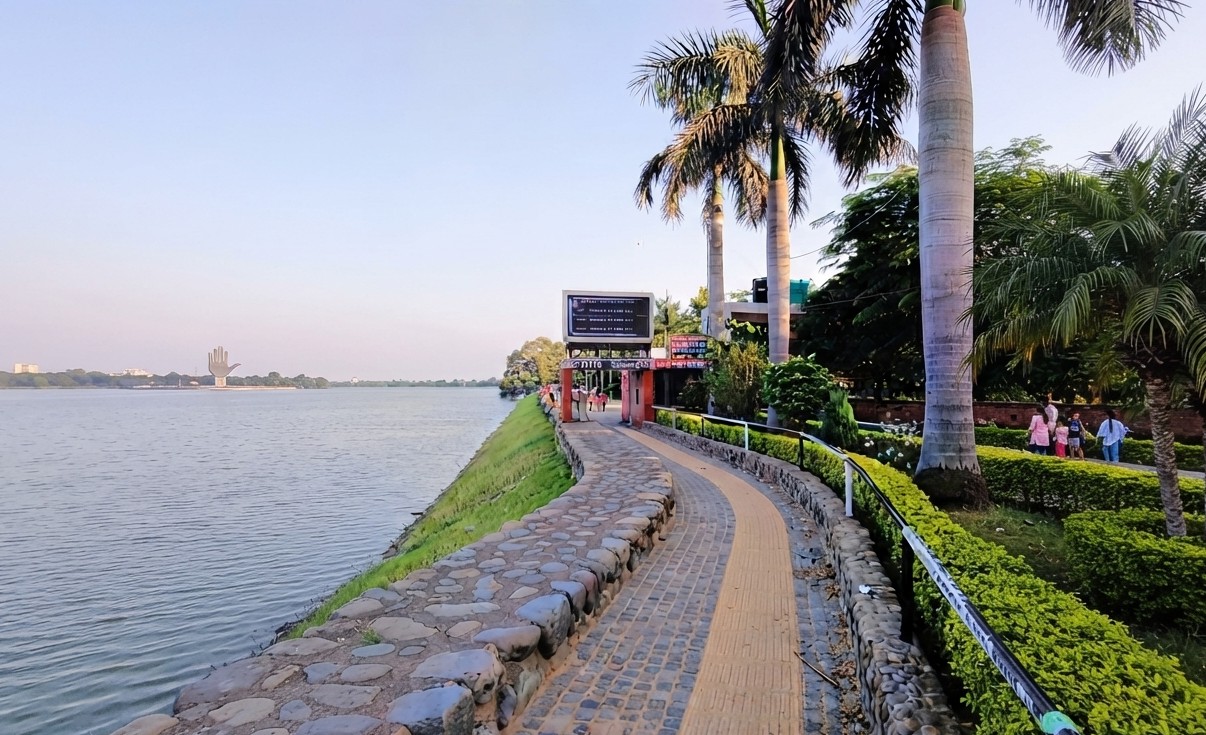
The Rock Garden, created by government official Nek Chand from industrial and household waste, spans several acres of sculpture gardens near the Capitol Complex. Nearby, Sukhna Lake offers a boating and walking promenade that draws both morning joggers and evening tourists throughout the year. Additionally, the lake hosts an annual carnival that attracts craftspeople and performers from across the region.
Rose Garden and Capitol Complex
Zakir Hussain Rose Garden, spread across 30 acres in Sector 16, holds over 1,600 varieties of roses and ranks among Asia’s largest gardens of its kind. Meanwhile, the Capitol Complex earned UNESCO World Heritage status in 2016 as part of a wider listing of Le Corbusier’s architectural works. Visitors can also explore the Government Museum and Art Gallery, which houses Gandhara sculptures and Pahari miniature paintings.
Chandigarh’s Economy, Education, and Healthcare
Education Hub: Panjab University and Beyond
Panjab University, established in 1882 and relocated to Chandigarh after partition, anchors the city’s higher education scene alongside Chandigarh University and Chitkara University in the surrounding region. Consequently, Chandigarh attracts students from Punjab, Haryana, and Himachal Pradesh for both undergraduate and professional programs.
Healthcare: PGIMER and Government Hospitals
The Post Graduate Institute of Medical Education and Research, widely known as PGIMER, ranks among India’s top referral hospitals and draws patients from across North India. Government Medical College and Hospital, Sector 32, supplements PGIMER’s capacity for the local population. As a result, Chandigarh has become a regional healthcare destination well beyond its own borders.
Chandigarh’s Climate and Best Time to Visit
Chandigarh experiences a humid subtropical climate with sharp seasonal swings. Summers run from April to June, when temperatures often cross 40°C, followed by a monsoon season from July through September, and dry, cool winters last from December to February with frequent morning fog.
Therefore, most travelers prefer visiting between October and March, when daytime temperatures stay comfortable and outdoor sightseeing around Sukhna Lake or the Rose Garden is far more pleasant. You can check the city’s current conditions anytime with our live Chandigarh air quality checker.
Chandigarh, Mohali, and Panchkula: Understanding the Tricity
Chandigarh rarely stands alone in daily conversation, since Mohali (in Punjab) and Panchkula (in Haryana) border it so closely that residents commonly refer to the combined region as the “Tricity.” Commuters frequently cross between the three areas for work, and several IT parks and residential developments have expanded across the Mohali side in particular.
Consequently, many services, from cab rides to food delivery, treat the Tricity as one connected market rather than three separate cities. For more on getting around the wider region, see our Chandigarh travel and stay guides.
Getting To and Around Chandigarh
Chandigarh International Airport connects the city to major Indian metros and a handful of international routes. Chandigarh Railway Station links to Delhi, Amritsar, and other North Indian cities, while the interstate bus terminals in Sector 17 and Sector 43 handle regional bus travel.
Within the city, the Chandigarh Transport Undertaking runs local buses, and app-based cabs cover most sectors reliably. If you’re planning a trip from a specific city, our Chandigarh distance and travel time calculator covers road distance and drive time to popular destinations.
Why Chandigarh Matters Today
Chandigarh’s planning legacy influences urban design conversations well beyond India, since planners still cite its sector-based model when discussing walkable, self-contained neighborhoods. However, the city also faces modern pressures, including housing demand from Mohali and Panchkula, which together with Chandigarh form the Tricity region.
Therefore, understanding Chandigarh today means looking at the original plan alongside the newer growth happening just across its borders. For official civic information, the Chandigarh Administration’s official website remains the most authoritative source.
Frequently Asked Questions
Is Chandigarh a state or a Union Territory?
Chandigarh is a Union Territory, not a state. It has its own administration but reports directly to India’s central government, while separately serving as the shared capital of Punjab and Haryana.
Is Chandigarh a city in Punjab?
No. Chandigarh is a separate Union Territory and does not belong to Punjab or Haryana, even though it serves as the capital for both.
Why is Chandigarh so famous?
Chandigarh is famous as India’s first fully planned city, designed largely by Le Corbusier after independence. Its sector-based layout, wide green belts, and modernist government buildings, several of which hold UNESCO World Heritage status, set it apart from older Indian cities.
Why is there no Sector 13 in Chandigarh?
Le Corbusier left the number 13 out of the original 1951 plan due to a common superstition, so the grid skipped straight from Sector 12 to Sector 14 for over 50 years. The UT Administration fixed this in February 2020, officially renaming Mani Majra as Sector 13.
Is Chandigarh an expensive city to live in?
Chandigarh ranks as a moderately expensive city by Indian standards, with housing costs higher than most Punjab and Haryana towns but lower than metros like Delhi or Mumbai. Daily expenses for food and transport remain reasonable compared with major metros.
What is Chandigarh best known for?
Chandigarh is best known for its planned sector grid, the Rock Garden, Sukhna Lake, and its Le Corbusier-designed Capitol Complex, alongside its reputation as one of India’s cleanest and most walkable cities.
Final Thoughts
Chandigarh’s story shows what deliberate planning can achieve when a government commits to a long-term vision, even when that vision creates ongoing debates about identity and governance. For anyone visiting or relocating, the sector system makes the city easy to navigate once you understand its logic.
Looking ahead, Chandigarh’s challenge will be balancing its heritage status with the practical pressures of a growing Tricity region, and how the administration handles that balance will shape the city’s next fifty years.